
Coffee
Here’s a claim that gets repeated at every coffee counter with total confidence: dark roast is stronger, so dark roast has more caffeine. It’s a clean piece of logic. It’s also backwards, or at least badly incomplete, and it’s worth running down properly instead of just asserting the opposite and moving on. That’s because the real mechanism is more interesting than either version of the myth, and it changes what you should actually do about it.
Why Everyone Assumes Dark Roast Hits Harder
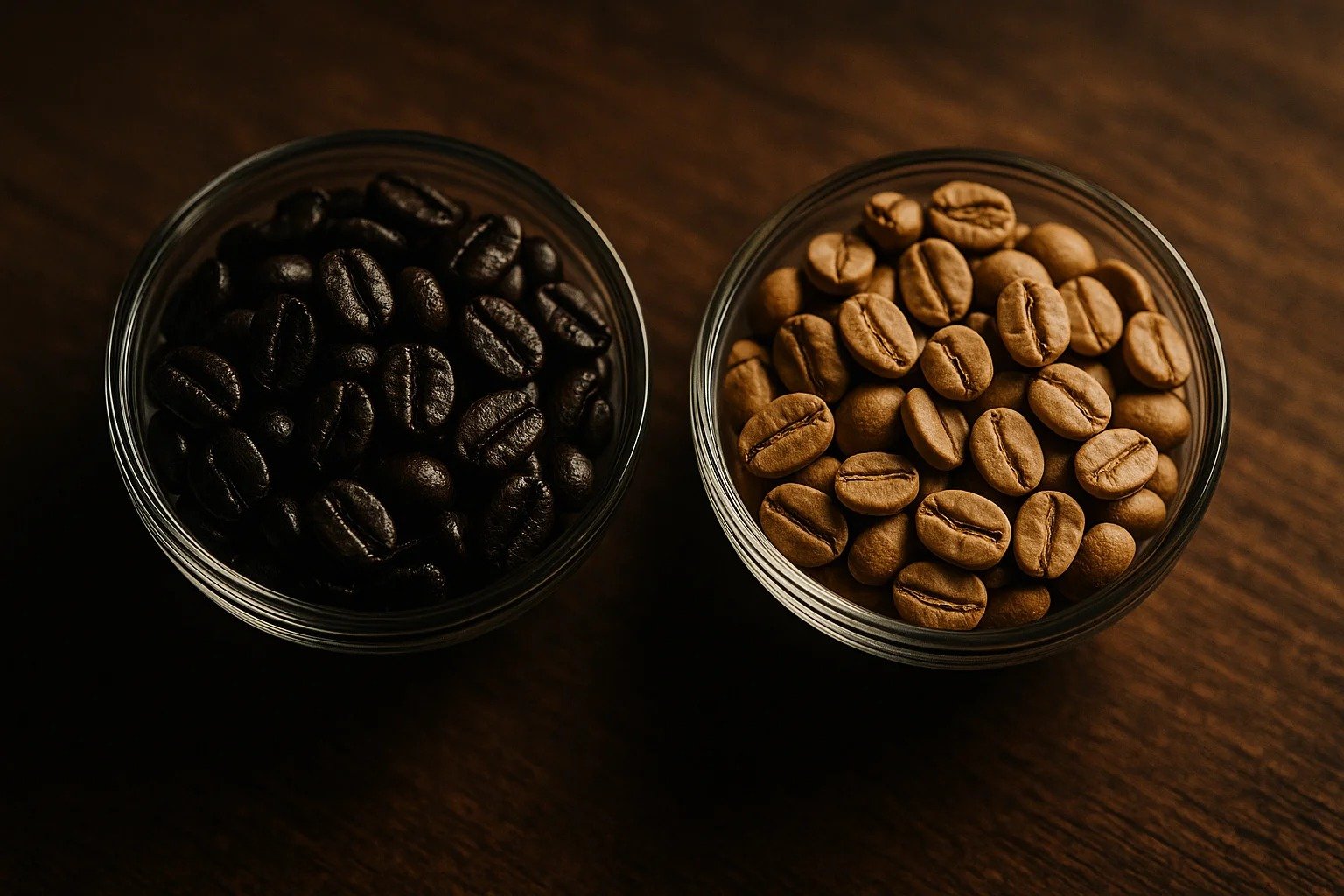
The assumption isn’t stupid — it’s just measuring the wrong thing. Dark roast tastes bolder, heavier, more bitter, sometimes almost smoky. Roasting longer and hotter builds those flavors by breaking down chlorogenic acids and building new bitter compounds through the same browning reactions (Maillard and caramelization) that darken bread crust and toast. None of that chemistry has much to do with caffeine, which is a comparatively rugged molecule that doesn’t track taste intensity at all. “Tastes stronger” and “has more caffeine” got bundled together because they both sound like “more,” and nobody ever ran the actual test at home to check.
By Weight: The Gap Is Small, and It Doesn’t Favor Dark
Start with the fair comparison: same weight of ground coffee, same brew method, same everything else. A 2024 study in Scientific Reports that brewed filter coffee across a range of roast levels at identical dose found caffeine concentrations clustering between roughly 134 and 165 mg per 8-ounce cup. The darkest roasts landed at the low end of that range, not the high end. That’s the opposite direction of the popular assumption, though the honest read is that the weight-for-weight gap between roast levels is modest, not dramatic.
There’s a real mechanism behind even that small dip, and it’s not that caffeine “burns off” easily. It’s a notably heat-stable molecule compared to most of the other compounds in a coffee bean. But it isn’t indestructible. Research on roasting thermodynamics points to caffeine sublimation becoming meaningful once bean temperatures push past roughly 400–420°F, which is deep into dark-roast territory and beyond where light or medium roasts ever get dropped. That’s a plausible explanation for why very dark roasts can end up a shade lower in caffeine by weight, while light and medium roasts stay close to each other. Either way, if you’re only comparing gram for gram, roast level is a minor lever — the myth doesn’t hold up, but it doesn’t dramatically reverse here either.
By the Scoop: This Is Where the Real Gap Shows Up
Almost nobody measures coffee by weight at home. Most people use a scoop — a fixed volume, not a fixed mass — and that’s where roast level stops being a minor lever and starts being a real one, because light and dark roast beans are not the same density.
Roasting drives moisture and gas out of the bean and makes it expand. The longer and hotter the roast, the more pronounced both effects are. Published roast-loss figures from green-coffee trade sources put a light roast’s mass loss at roughly 10–12% of its original green weight, climbing to roughly 20–25% for a dark roast taken well past second crack. A dark roast bean has lost more mass and puffed up more than a light roast bean — meaning it’s measurably less dense. Scoop by volume instead of weighing, and a level scoop of dark roast simply contains less actual coffee mass than the same scoop of light roast.
The Result: Less Caffeine in the Cup
Less coffee mass in the scoop means less total caffeine in the pot, on top of whatever small per-gram difference exists from the weight comparison above. When America’s Test Kitchen ran this as a side-by-side test — same scoop, different roasts — they measured up to 60% more caffeine in the light roast pot than the dark roast pot, even though the beans themselves were in the same ballpark by weight. That’s not a rounding error. That’s the whole myth, reversed, hiding in a kitchen drawer.
| Roast | Typical roast loss | Beans in a level scoop (illustrative) | Approx. mass in scoop | Approx. caffeine |
|---|---|---|---|---|
| Light roast | ~10–12% | denser, more mass per scoop | 10.5 g | ~126 mg |
| Dark roast | ~20–25% | less dense, less mass per scoop | 8.5 g | ~102 mg |
Illustrative example, not a lab measurement — built from published roast-loss ranges (light ~10–12%, dark ~20–25%) and a representative ~1.1–1.2% caffeine-by-weight figure, using a level tablespoon-style scoop as the fixed volume. Your actual grams-per-scoop will vary by bean, roast profile, grind, and scoop shape. The point is the direction and rough scale of the gap, not these exact milligrams for your specific bag.
How to Actually Get the Caffeine You’re Expecting
If caffeine amount actually matters to you — you’re cutting back, timing a dose before a workout, or just tired of one pot hitting different from the last — the fix isn’t picking a roast color, it’s picking up a scale. Weighing your dose is the only way to hold caffeine roughly constant while you experiment with roast level, grind, or brew method, because weight is the one variable density can’t quietly mess with.
And if you’re going to keep scooping, which most people reasonably will, know what you’re actually doing. Reaching for a dark roast at night because it “feels like less caffeine” happens to line up with the real effect, just not for the reason you’d guess — it’s the lower density per scoop doing the work, not some caffeine-destroying dark-roast intensity. Reach for a dark roast expecting it to hit harder in the morning, though, and you’re scooping yourself less caffeine than a light roast would’ve given you from the exact same scoop. Test it yourself with a kitchen scale before you trust either version of the story, including this one.
Run Your Life on Your Own Terms
The Keep — coffee, liberty, and capital, one email a week. No fluff, no spin.

Theo Callahan
Tests coffee’s technical claims against the actual mechanism instead of the received wisdom — roast science, brew method, and product-category retesting. Distrusts a claim until it’s been run side by side.
More like this: The Coffee Guide indexes everything we have published in this pillar.