
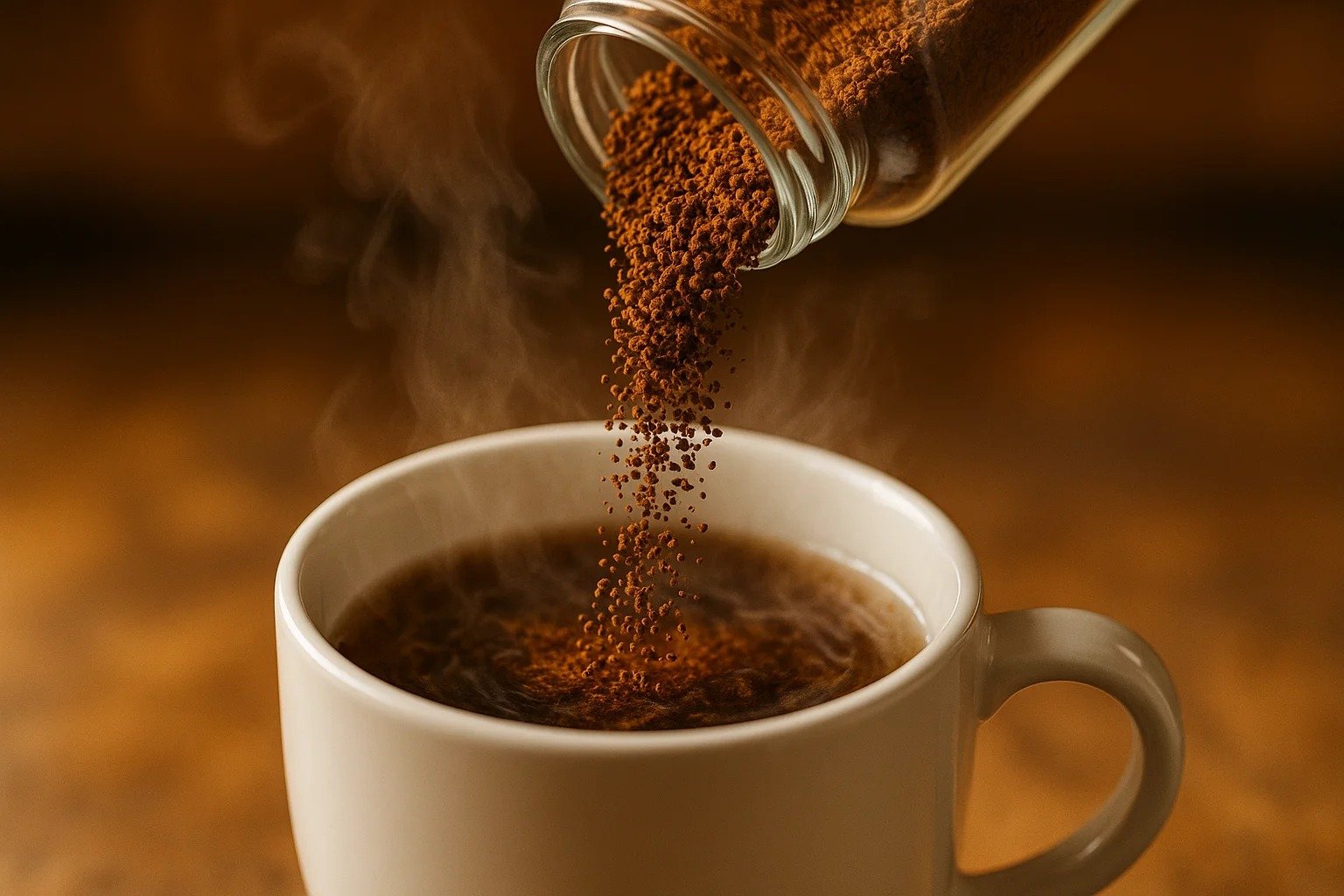
Coffee
Ask most people why instant coffee is bad and they’ll describe a specific cup: bitter, flat, a little metallic, tasting more like “coffee-flavored” than coffee. Ask them when they last actually tried a jar and the answer is usually “years ago,” if ever on purpose. That’s the gap worth testing, not assuming: in an October 2025 blind taste test run by Drexel University’s Food Lab for The Guardian’s Filter newsletter, 77% of tasters picked an instant coffee over drip when neither was labeled. Not a boutique freeze-dried single-origin against gas-station drip — instant, full stop, against drip brewed from Folgers, Stumptown, and La Colombe. The common assumption about instant coffee runs backwards often enough now that it’s worth figuring out exactly where the gap actually closed, and where it’s still real.
Why the Reputation Never Caught Up to the Process
Instant coffee’s reputation was built by a specific manufacturing choice, not by coffee itself. Spray-drying — atomizing liquid coffee concentrate into fine droplets and blasting them through a chamber of hot air until the moisture flashes off — was scaled up for WWII-era bulk military production, optimized for shelf stability and cost, not flavor. That’s the process behind most of the mass-market jars that trained a couple of generations to associate “instant” with “bad”: cheap, heat-blasted, often built on commodity Robusta rather than Arabica.
Freeze-drying existed as an alternative by the 1960s and preserves meaningfully more of the coffee’s original character. But it never fully rewrote the category’s reputation, mostly because the freeze-dried option sat quietly next to the spray-dried one on the same shelf without the difference being explained to anyone buying it. Nescafé still sells both today: Original, spray-dried, runs around $12.99 for a standard jar, while Nescafé Gold, freeze-dried, runs closer to $24.99 for a comparable size — nearly double, for the same brand, same beans-adjacent sourcing, different process. That price gap is the company quietly admitting the difference is real, even while the marketing on the shelf mostly doesn’t say so.
Freeze-Dried vs. Spray-Dried: The Difference That Actually Explains It
Freeze-drying works by freezing concentrated coffee solid, then holding it in a vacuum chamber where the ice sublimates — goes directly from solid to vapor without passing through a liquid stage. It’s slower and more expensive. But because the coffee is never exposed to sustained high heat, it holds onto far more of the volatile aromatic compounds that make coffee smell and taste like coffee rather than like a vague brown liquid. Spray-drying skips straight to heat. Concentrate gets atomized into a fine mist and dried almost instantly in a hot-air chamber, which is fast and cheap but strips out a lot of that same aromatic complexity along the way. That’s the mechanism behind the “flat, slightly burnt” taste that gave instant its name-brand reputation.
The Brands Actually Doing This
Every specialty single-origin instant brand on the market right now is leaning on that same freeze-dried process, just applied to better source coffee instead of commodity blends. Mount Hagen uses organic, fair-trade, single-origin Arabica from Papua New Guinea. Waka Coffee freeze-dries 100% Arabica from Colombia; Saturnbird, a newer entrant, uses a proprietary freeze-drying method it markets as “ZEROLOSS” on Arabica sourced from Panama, Colombia, and Yunnan. Starbucks VIA takes a slightly different hybrid approach, blending freeze-dried coffee with “microground” particles of actual roasted coffee fine enough to dissolve — an attempt to get closer to steeped-coffee texture rather than a pure soluble powder. None of this is new chemistry. It’s the same sublimation process that’s existed for decades, just finally being pointed at coffee worth preserving instead of coffee that only needed to survive a supply chain.
| Process | How it works | Where it typically shows up | Aroma retention |
|---|---|---|---|
| Freeze-dried | Frozen concentrate, moisture removed by vacuum sublimation | Specialty/single-origin lines, premium tins (Mount Hagen, Waka, Saturnbird, Nescafé Gold) | Higher — minimal heat exposure |
| Spray-dried | Liquid concentrate atomized, dried instantly in hot air | Mass-market bulk jars (Nescafé Original, most store-brand tins) | Lower — heat strips volatile compounds |
Process descriptions and brand-process pairings verified via web search on 2026-08-02 against current production and retail sourcing; not a controlled lab instrument test of any specific jar.
What Happens When You Actually Blind-Test It
The Drexel Food Lab study, led by Jonathan Deutsch and Rachel Sherman, ran in two stages. An initial round of 84 tasters worked through 24 instant coffee varieties to identify the strongest performers. The finalists then went head-to-head against three drip coffees — Folgers, Stumptown, and La Colombe, each brewed to manufacturer spec — with 44 tasters blind-rating five 2-ounce cups apiece on acidity, bitterness, texture, flavor, aftertaste, and overall preference, with none of the cups labeled by brand or brewing method.
The result: 77% picked an instant coffee as their overall favorite. The winner wasn’t an ultra-premium specialty jar — it was Illy Intenso Bold Roast, a widely available grocery-store product, praised for its balance of acidity and bitterness and a body tasters didn’t expect from something soluble. Mount Hagen’s freeze-dried organic fair-trade instant came in as runner-up, liked by 41% of the panel — notably, the one specialty single-origin freeze-dried entrant that cracked the top tier.
Deutsch’s own read on the result is the interesting part. An upscale reinterpretation of a familiar product doesn’t automatically beat a well-executed version of the original — the same reason ketchup snobs still mostly land on Heinz. That’s worth taking at face value and also worth not overreading. Forty-four tasters in a single published study, cupped at a specific set of temperatures, against three specific drip options that weren’t necessarily brewed at peak freshness, is a real result and not a settled one. It’s one well-run test, not a meta-analysis. What it does establish is that “instant coffee is categorically worse” no longer survives contact with an actual blind cup, at least often enough that the stereotype deserves to be retested rather than repeated.
Where the Gap Is Still Real
Two things the blind-cupping result doesn’t settle: price and mouthfeel. Specialty freeze-dried instant isn’t the cheap-and-convenient option anymore — it’s priced like the specialty coffee it’s trying to replace. As of 2026 retail listings, Mount Hagen runs roughly $0.48–$0.52 per serving, Waka runs roughly $0.63–$0.80 per serving, and Saturnbird runs closer to $1.20 per serving — against Nescafé Clásico’s spray-dried baseline of about $0.07 per serving. A reasonable illustrative estimate for a cup of mid-range fresh-ground drip coffee brewed at home, based on typical grocery bean pricing, lands somewhere in the same $0.30–$0.60 range as the mid-tier specialty instant options — meaning the “instant is the cheap shortcut” framing only holds if you’re comparing fresh-ground against the bottom of the instant shelf, not the top.
| Product | Process | Approx. cost per serving |
|---|---|---|
| Nescafé Clásico Dark Roast | Spray-dried | ~$0.07 |
| Mount Hagen Organic Freeze-Dried | Freeze-dried, single-origin | ~$0.48–$0.52 |
| Waka Coffee Medium Roast | Freeze-dried, single-origin | ~$0.63–$0.80 |
| Saturnbird Instant | Freeze-dried, single-origin | ~$1.20 |
| Fresh-ground drip, mid-range beans | N/A | ~$0.30–$0.60 (illustrative estimate) |
Per-serving instant coffee pricing reflects 2026 retail listings surveyed via web search on 2026-08-02 and will drift with retailer pricing over time. The fresh-ground drip row is an illustrative estimate based on typical mid-range grocery bean pricing, not a sourced figure for any specific product. It’s included to show the ranges now overlap, not to claim an exact number.
What a Blind Cup Can’t Measure
The mechanical gap hasn’t closed either, even on the freeze-dried side. Instant coffee, however it’s dried, is fully soluble — there’s no sediment, no coffee oils carried into the cup, none of the crema an espresso shot produces or the body a French press leaves behind. That’s invisible in a black-cup blind test, which is exactly the format the Drexel study used, and exactly why its result is real but scoped. It says instant can win on flavor and balance in a black cup, side by side, blind.
It doesn’t say instant has closed the gap for a latte, a pour-over ritual someone actually enjoys the process of, or anything where texture and technique are the point rather than a means to caffeine. If your criteria are “does this taste good black, quickly, judged on its own merits,” the honest answer in 2026 is that a meaningful slice of the instant category has actually caught up. If your criteria include the physical process of making it, it hasn’t, and freeze-drying was never trying to solve that problem in the first place.
Run Your Life on Your Own Terms
The Keep — coffee, liberty, and capital, one email a week. No fluff, no spin.

Theo Callahan
Tests coffee’s technical claims against the actual mechanism instead of the received wisdom — roast science, brew method, and product-category retesting. Distrusts a claim until it’s been run side by side.
More like this: The Coffee Guide indexes everything we have published in this pillar.