
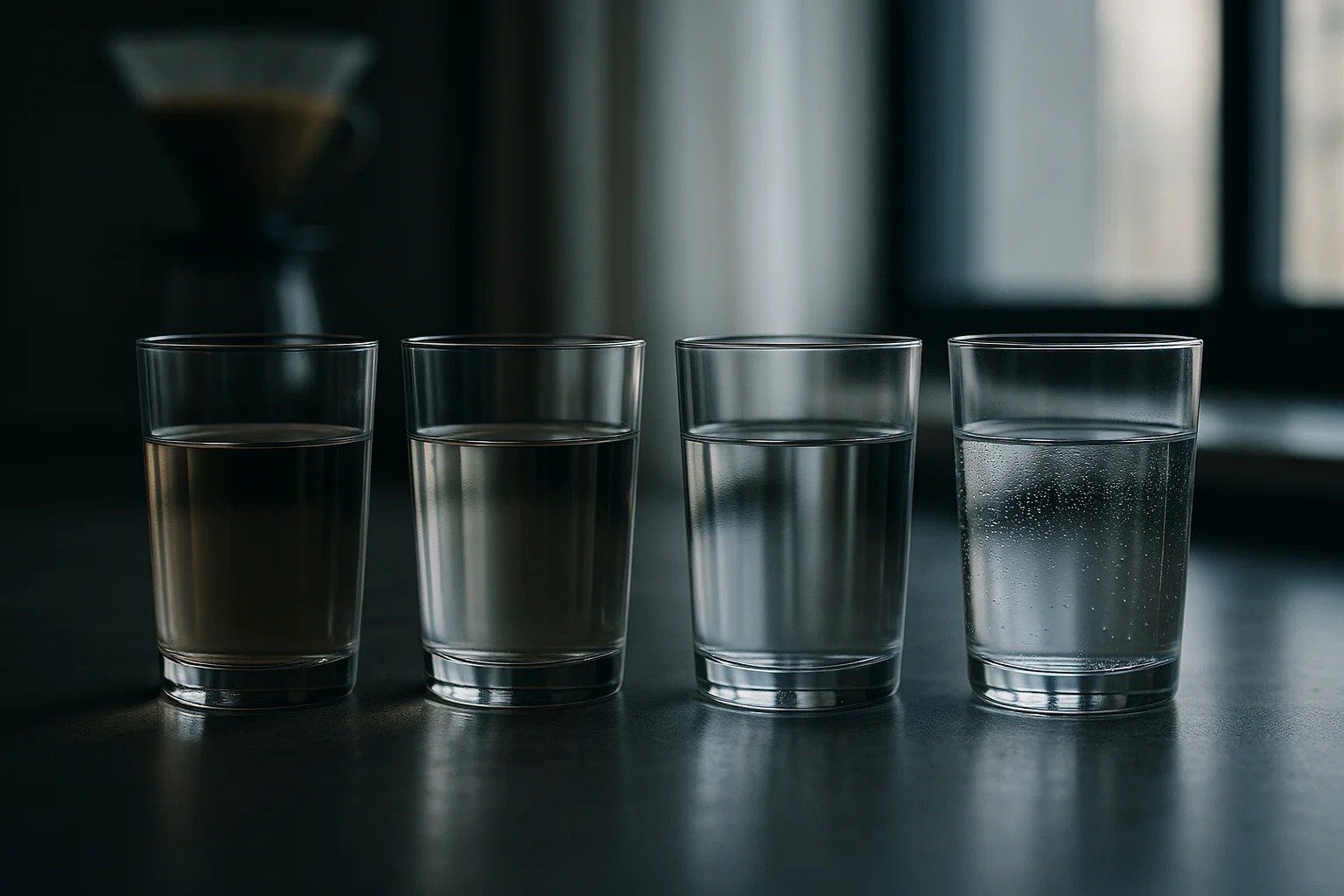
Coffee is roughly 98% water by weight, which means the water is doing almost all of the physical work of extraction — and it’s the variable most home brewers never touch. People will argue for twenty minutes about grind size and then brew with whatever comes out of the tap without a second thought. That’s backwards. Water chemistry changes what actually gets pulled out of the grounds, and the difference between “flat” and “sour” and “just right” often has nothing to do with your grinder. Here’s what tap, filtered, bottled, and remineralized water each actually contain, tested against the industry’s own published standard instead of vibes.
Why Water Is 98% of the Cup and Still Gets Ignored
Extraction is a chemical handoff. Hot water pulls acids, sugars, and aromatic compounds out of ground coffee, and dissolved minerals in that water — mainly calcium and magnesium — are what actually bind to and carry those flavor compounds into solution. Water with essentially zero mineral content, like pure distilled or reverse-osmosis water, has nothing to grab onto those compounds with, so the resulting cup tastes thin and underextracted even with a perfect grind and ratio.
Water loaded with minerals, on the other hand, extracts fast and heavy, muting acidity and pushing the cup toward bitter or flat-tasting. Chlorine and chloramine, common tap-water disinfectants, don’t help extraction at all — they just react with coffee compounds to create their own off-flavors. None of this is a matter of taste preference; it’s measurable water chemistry, and it’s the reason the Specialty Coffee Association publishes an actual numeric target instead of leaving it to guesswork.
The Actual Mineral Target: SCA’s Golden Cup Standard
The SCA’s water standard gives a target value and an acceptable range for each parameter, not just a vague “use good water” suggestion:
| Parameter | Target | Acceptable Range |
|---|---|---|
| Total dissolved solids (TDS) | 150 mg/L | 75–250 mg/L |
| Calcium hardness | 68 mg/L | 17–85 mg/L |
| Total alkalinity | 40 mg/L | 40–70 mg/L |
| pH | 7.0 | 6.5–7.5 |
| Sodium | 10 mg/L | below 30 mg/L |
| Chlorine/chloramine | 0 mg/L | 0 mg/L |
Figures are the published SCA Golden Cup water standard, sourced and verified for this piece — not illustrative estimates.
Notice how narrow that band is. A “medium hardness” municipal water supply and a “soft” one can both sound perfectly normal to a homeowner and still land on opposite sides of that calcium-hardness range. And chlorine gets zero tolerance, full stop — there’s no acceptable amount, because even trace levels change the flavor chemistry.
Tap vs. Filtered vs. Bottled vs. Remineralized, Side by Side
Tap water is the biggest variable of the four, because it’s not one thing. It’s whatever your specific municipal supply happens to be, and that varies block to block, let alone city to city. Some utilities run soft, low-mineral water; others sit well above the SCA’s upper bound for hardness, which is also why some cities’ coffee makers scale up with mineral buildup twice as fast as others. Nearly all municipal tap water also carries some chlorine or chloramine for disinfection, which puts it in direct conflict with the SCA’s zero-tolerance line before you even get to the hardness numbers.
Filtered water (a standard pitcher or fridge filter) knocks out most chlorine taste and some hardness, but it’s not calibrated to hit the SCA range. It’s calibrated to make tap water taste less like tap water. Depending on your starting tap chemistry, a basic carbon filter can land you inside the acceptable band by luck, or still leave you outside it.
Bottled and Remineralized: The Manufactured Options
Bottled water is the widest range of the four, because “bottled” covers wildly different mineral profiles. Fiji water tests around 210 mg/L TDS — inside the SCA’s acceptable range, on the higher side. Evian runs closer to 357 mg/L TDS, meaningfully above the SCA’s 250 mg/L ceiling. Heavily mineralized waters like San Pellegrino sit over 1,100 mg/L TDS — nowhere near coffee-appropriate, since that bottle was never designed with brewing in mind. Vapor-distilled waters with electrolytes added back (the Smartwater category) start from near-zero TDS and add some minerals back for taste, though brands in that category don’t typically publish an exact TDS figure on the label, so treat any specific number for that style as unconfirmed rather than fact.
Remineralized water is the only one of the four actually built around the SCA target rather than incidentally landing near it. Third Wave Water‘s packets, the best-known product in this category, run about $18 for a 12-pack, with each packet dosing one gallon of distilled or reverse osmosis water — call it roughly $1.50 per gallon in mineral-packet cost alone, on top of whatever the base distilled or RO water costs. The classic formula adds magnesium sulfate, calcium citrate, and sodium chloride; an espresso-specific formula swaps in potassium bicarbonate for extra buffering capacity. It’s a real, deliberate way to hit the SCA numbers on purpose instead of hoping your tap does.
Where the Difference Shows Up, and Where It Disappears Into Noise
Here’s the part that actually matters for whether you should care. If your tap water doesn’t taste or smell like a swimming pool and doesn’t leave visible scale buildup on your kettle within a few weeks, it’s probably close enough to the SCA range that switching to remineralized water won’t transform your cup. Where the difference becomes obvious is at the extremes.
Water that’s genuinely soft or run through a whole-home softener can taste noticeably flat and underextracted no matter how well you dial in grind and ratio. That’s because there’s nothing in the water to carry the flavor. Water that’s genuinely hard does the opposite: muted, sometimes chalky-tasting coffee, plus a machine that scales up and needs descaling far more often than the manufacturer’s default schedule assumes. And any water with detectable chlorine taste is worth filtering regardless of hardness, since that’s the one variable the SCA standard treats as non-negotiable.
If you’ve already nailed grind size, dose, and brew ratio and you’re still not happy with the cup, water is the next lever worth pulling. And it’s worth actually testing your specific tap water’s hardness (cheap test strips exist for exactly this) before spending money assuming a filter or bottled water will fix a problem your tap doesn’t actually have.
Run Your Life on Your Own Terms
The Keep — coffee, liberty, and capital, one email a week. No fluff, no spin.

Theo Callahan
Tests coffee’s technical claims against the actual mechanism instead of the received wisdom — roast science, brew method, and product-category retesting. Distrusts a claim until it’s been run side by side.
More like this: The Coffee Guide indexes everything we have published in this pillar.