
Capital
“I always pay at least the minimum” is not a plan. It’s the slowest, most expensive way to pay off a balance that credit card companies are legally allowed to offer you, and most people don’t know that by design.
How the minimum payment is actually calculated
Formulas vary more than most people realise. Many large issuers use roughly 1% of the balance plus that month’s accrued interest and fees; credit unions and subprime lenders more often use a flat 2% to 4% of the balance with the interest already folded in. Either way a floor applies once the balance gets small, usually somewhere around $25 to $40. As your balance drops, your required minimum drops too — which sounds helpful and is actually the mechanism that stretches payoff time out for years.
What paying only the minimum actually costs
| Starting balance | APR | Approach | Time to pay off | Total interest paid |
|---|---|---|---|---|
| $5,000 | 22.15% | Minimum only — interest plus 1% of balance | 19 years, 3 months | $8,159 |
| $5,000 | 22.15% | Minimum only — flat 2% of balance | 86 years, 7 months | $47,152 |
| $5,000 | 22.15% | Fixed $150 every month | 4 years, 5 months | $2,834 |
Computed with the calculator below, not estimated. The APR is the Federal Reserve’s average rate on card accounts actually assessed interest — 22.15%, G.19, May 2026. Both minimum formulas above are in common use, and which one your issuer applies changes the answer by decades, which is the whole point. A $25 floor applies once the required payment falls below it; the model assumes no new charges and no fees.
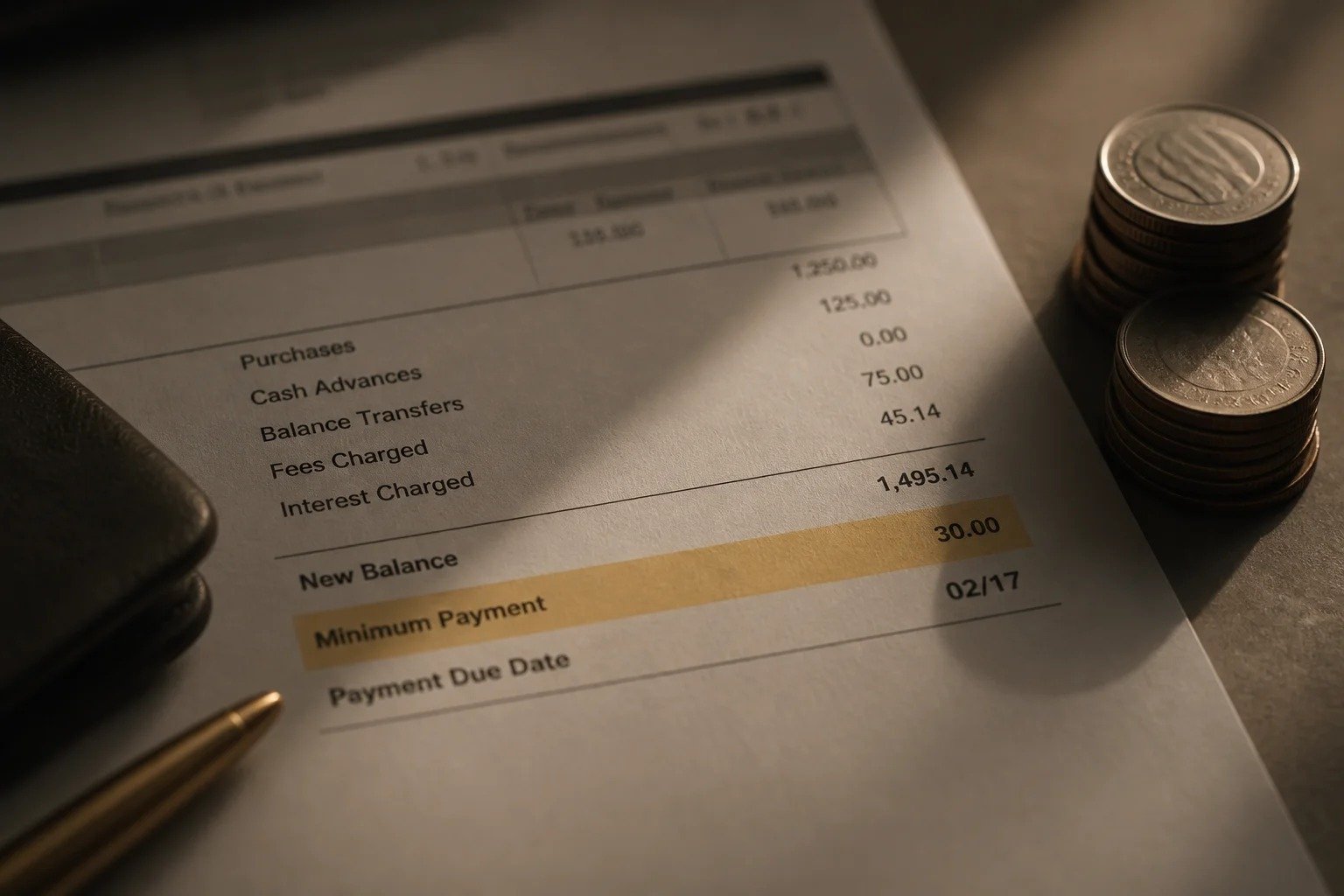
A real balance, paid at the minimum
The mechanism: each month the minimum shrinks as the balance shrinks, so a huge share of every payment for years goes to interest, not principal, especially early on. This is why a $5,000 balance can generate more in total interest than the original purchase amount if left on minimum payments long enough.
The one number that actually fixes this
Pick a fixed payment amount — not a percentage, an actual dollar figure — meaningfully above the minimum, and keep paying that same fixed number every month even as the balance and required minimum drop. That single change is what collapses a 19-year payoff into four and a half — and $200 a month instead of $150 takes it under three. Run your specific numbers through the calculator below before deciding on the figure — don’t guess.
Run it on your own numbers
Default APR is 22.15% — the Federal Reserve's average rate on card accounts actually assessed interest (G.19, May 2026). Assumes no new charges and a rate that does not change.
| Month | Payment | Interest | Principal | Balance |
|---|
Average APR from the Federal Reserve G.19 release, commercial bank interest rates on credit card plans, accounts assessed interest (22.15%, May 2026). Minimum-payment formulas vary by issuer; both options offered here are common ones. The model assumes no new charges and no fees, and caps payoff at 120 years.
Run Your Life on Your Own Terms
The Keep — coffee, liberty, and capital, one email a week. No fluff, no spin.
Devon Marsh
Covers Capital with one rule: no vague claims. If it’s not a real number, it doesn’t make the piece. Direct, high-energy, allergic to hand-waving.
More like this: The Capital Guide indexes everything we have published in this pillar.